

The history of the elevator
Already since 236 A.D., as Roman architect Vitruvius mentions, there were systems similar to today’s elevators in royal palaces. According to ancient Roman historians, they were the first to have constructed special platforms which would ascend to significant height with the help of ropes. Leaving Rome and travelling to Tibet or our country, we find the first elevators in the form of baskets, which lift people and goods e.g. in the monasteries of Meteora. In ancient Greece, Archimedes invented a lifting mechanism which operated with ropes an pulleys and in which the lifting ropes were wrapped around a winding drum via a “worker” and levers.
Until the 18th century the elevator had evolved. In 1743 Louis XV ordered a private elevator with counterweight for his apartments in Versailles. In 1833 in the Upper Harz Mountains in Germany they used a system of twin rods to transport miners in and out of the metal mines. In 1803-4 in England, one of the first mechanized lifting systems was installed, the “Teagle”, a belt driven platform lift used for transporting goods and workers in a five-story mill featuring some basic safety mechanisms. The first hydraulic industrial elevator (with water as hydraulic medium) which moved by pressure was constructed in 1846. As elevator mechanics improved, more lifting devices were invented, but without effective safety mechanisms. Every time a rope would break, passengers would free fall.
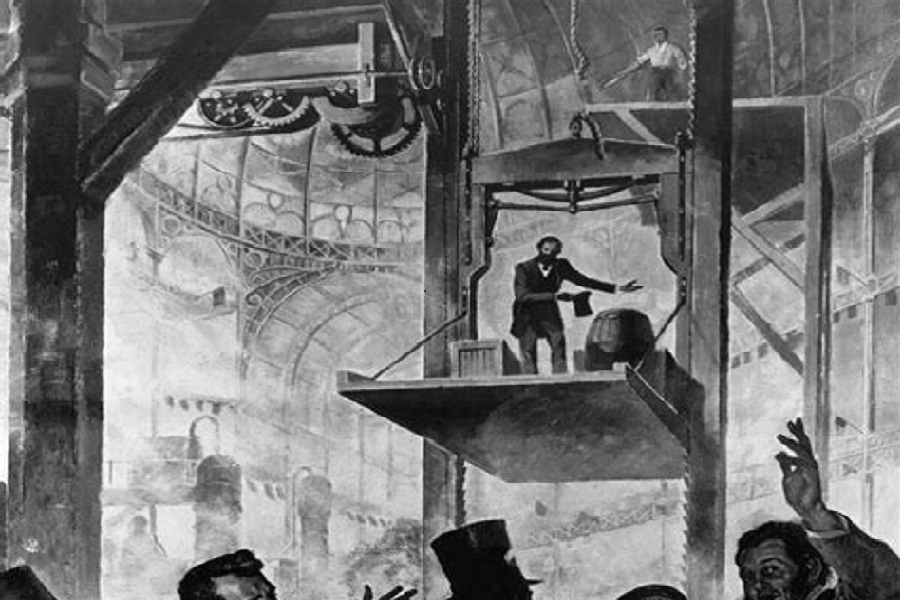
Meanwhile, the second half of the 18th century and the Industrial Revolution beginning in England saw the rise of steel and glass as commodity construction materials. In 1853, Elisha Graves Otis presents the first lifting device featuring an innovative safety system. In a show in New York’s Crystal Palace, Otis, in front of the terrified audience, cut the ropes holding the platform he was standing on. Whilst the platform started falling, suddenly it stopped. The elevator grab safety apparatus had worked. On 23rd March 1857, Otis installed the first safety passenger elevator in the E.V. Haughwout & Co. store in New York. The elevator was steampowered, using coal as fuel. From then onwards, the technology in the elevator sector has taken huge steps.
- In the 1870s the first hydraulic elevators operated in New York.
- In 1889 in the Demarest building in New York the first electric elevator operated.
- In 1894 in New York the first elevator with call buttons operated, without a person-driver.
- In 1900 the first electric escalator was presented in the Paris International Exhibition.
- In 1903 the first elevator with friction pulley (not a drum) and counterweight operated, that is in a form similar to how we know elevators today.
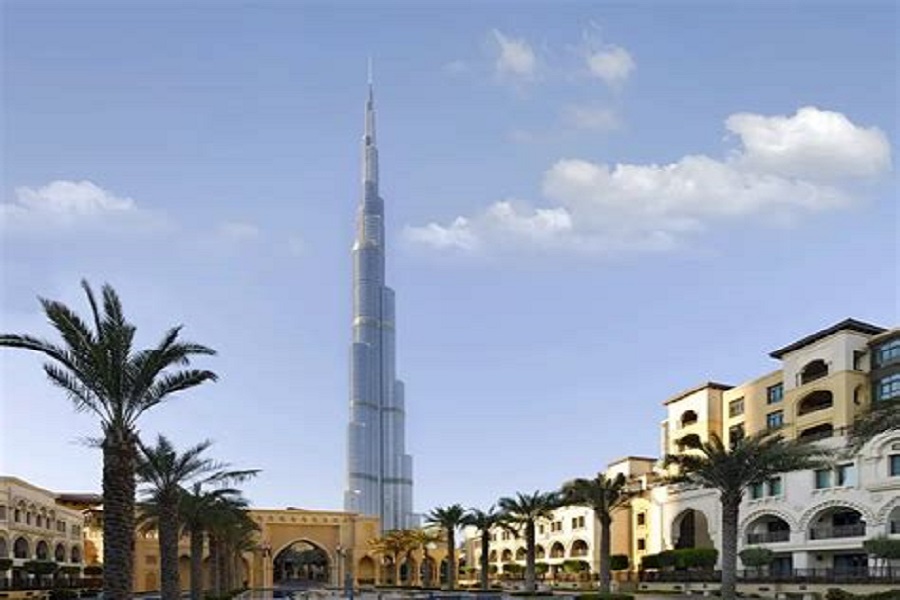
In 1915 the first so-called automatic levelling was presented and further, doors became automatic. With the increase of building heights, elevator speeds increased to 365 meters per minute in express installations such as those for the top last floor of the Empire State Building (1931), reaching 549 m/min in Chicago’s John Hancock Center (1970) and 600 m/min in Tokyo’s Sunshine 60 skyscraper in 1978. Today’s fastest elevator is installed in the iconic Burj Khalifa skyscraper in Dubai, of total height 830 meters. With a speed of 20,5 m/sec or 64 km/hour–while a conventional elevator reaches about 0,60-0,70 m/sec–it transfers passengers over 163 floors in minimum time. Impressively, skyscraper elevators feature an atmospheric pressure regulating system inside the cabin.
The evolution history of elevators is still written today, following the current technological revolution. A characteristic example is the Space-Elevator, already being designed by NASA and other organisations with global interests. The technical challenges of such an endeavor are extreme: the self-weight of the tether has to be adequate so that, on the one hand, it will not be attracted by gravity, but powerful enough to transfer weights to the point of the earth’s geostatic orbit (at a height of 35.800 km). Further, the structure will have to withstand wind pressure and extreme weather phenomena such as storms and typhoons. However, such a space elevator will create new possibilities for the transfer of people and materials into space, using renewable forms of energy and significantly decreasing the time required for transportation into space.