

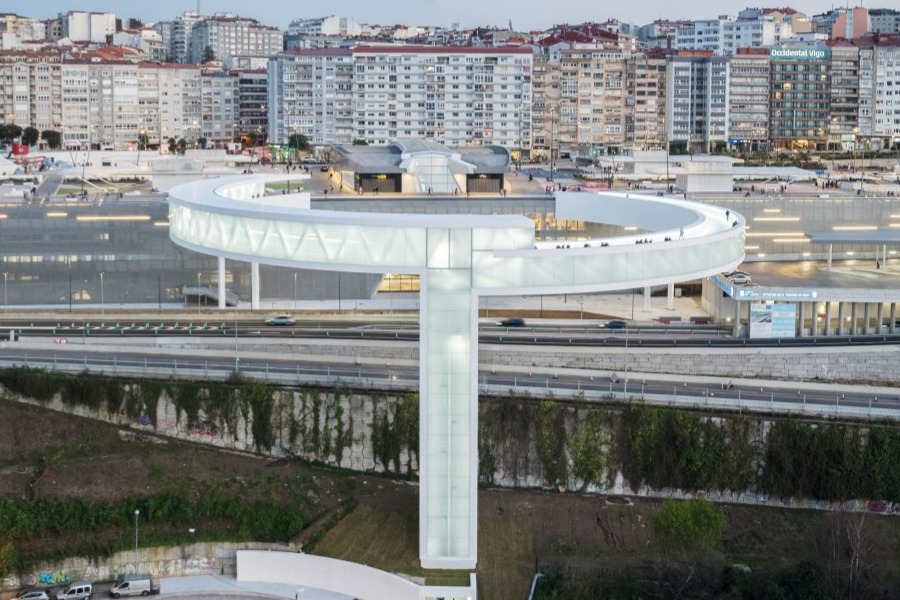
Halo in the city of Vigo, Spain
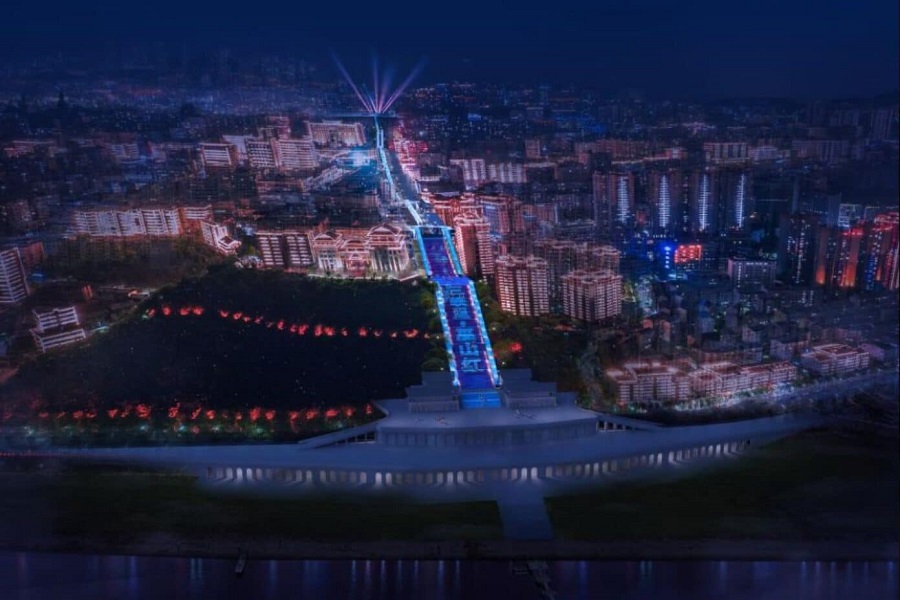
Halo is the new landmark in the urban geography of the city Vigo in Spain, built on hills with intense topography. The Municipality of Vigo applied an extensive connectivity plan in the northwestern part of the city, of which Halo is the most ambitious part. Designed to cover a height difference of 40 meters, the structure connects different neighbourhoods and offers accessibility to a new building complex (train station, bus station and commercial centre), while its 70 meters opening expands over a main highway.
The project design is a collaboration of the architectural practices Arenas & Asociados (specialization in bridge design), AM2 Arquitectos (Vigo) and NOARQ (Porto, Portugal), whose proposal was selected after an international competition held by the Municipality of Vigo in 2021. The construction was implemented by Ferrovial and Oreco Balgón.
Halo is composed from a circular footbridge and an elevator tower, in a sculptural architectural work which converses designwise with the adjacent building complex. The circular footbridge functions also as a never-ending walk with views of the Atlantic Ocean, alternating a covered part sheltered from the rain with an open, fully exposed to the surrounding landscape. The diameter of the circular footbridge is 84 m, whilst its clear width is 4,5 m. The construction of the bridge has been carried out with large scale steel elements, the voids of which the pedestrians have to pass through on their way to the footbridge.
The elevator tower houses two panoramic elevators, of 15 person capacity each (load capacity: 1275 kg), moving with a speed of 1,6 m/sec to cover the perpendicular distance of 40 m. The elevators are manufactured by Schindler, model 5500, fully adaptable to the special requirements of the project, technical and aesthetic. In Halo, the elevators have full-dimension glass cabin doors without frame, whilst a cabin cooling system has been installed. The energy for the elevator movement as well as night lighting is produced by two wind turbines incorporated in the construction.
Characteristic is the rescue system applied in case of failure in one of the two elevators: Schindler installed an extra internal emergency door in each of the cabins, additional to the two standard 180° dual-access doors. Since the two elevators travel in parallel within the same shaft, the functional elevator can be levelled up with the failed one. This allows the emergency doors to open and the passengers to move from one cabin to the other via a specially designed rescue bridge.
Halo was officially opened to the public on 16th February 2024, after 18 months of construction. It has already won multiple awards, for architectural and urban design and accessibility in Spain, as well as abroad. Besides being an impressive example of architecture and construction, Halo is a paradigm of strategic planning for contemporary cities inclusive for all, with reduced environmental footprint, with care for their aesthetic upgrade and urban cohesion. Halo promotes walking outdoors, attention to and taking pleasure in landscape views, contact with the weather, sociability between local residents and visitors to the city.
Article and image source: https://elevatorworld.com/article/halo/